
Simple Artist Roadmap: Turn Creative Chaos Into Digital Art Income

If your creative brain feels like a Pinterest board about to explode, you are in good company.
You have a dozen ideas, half-finished products, maybe a few lonely digital art listings sitting in your shop, and absolutely zero clear direction. It feels messy, loud, and kind of exhausting. But your messy brain is not the problem. The problem is having no roadmap for what to do with it.
This is a simple, no-fuss guide to help you monetize your digital art. We'll turn that chaos into a doable passive income stream from your digital art. One project at a time. No “perfect” plan, no 47-step funnel, no needing to have your whole business figured out before you upload one thing.
We are not trying to become perfectly organized robots here. We are trying to make art, sell digital art, and have it actually feel fun.
Let’s walk through the simple artist roadmap I use to turn ideas into income, tapping into the earnings potential of your creative chaos, without burning my brain to the ground.
Quick Start:
How to Monetize Your Digital Art
Dump your ideas somewhere safe
Pick one product idea that feels fun and doable
Design it, list it, don’t overthink it
Make mockups and use simple keywords
Track your wins and adjust — then rinse and repeat
Keep it playful so burnout doesn’t sneak in
Table of Contents

Step 1: Capture All That Creative Chaos
We are not starting with selling. We are starting with getting all that good, wild, scattered brain content out of your head and into a place where it can actually help you.
Right now your brain is trying to:
- Hold product ideas
- Remember color palettes
- Track that one really good sticker quote you thought of in the shower
- Keep up with platform rules
- Oh, and also live your actual life
No wonder it feels like noise. So first job: get it out.
You can use whatever feels natural to you:
- Notion board
- Spreadsheet
- Notebook
- Notes app on your phone
- Voice or video recorder
The tool doesn’t matter. What matters is this: put it somewhere you are not going to lose it. Ask me how I know.
Ask me how many notebooks I have started, loved, and then abandoned in some mysterious black hole of a drawer.
Pick one capture place that feels easy to open every day. That is key.
Then spend a little time brain-dumping:
- Product ideas
- Style or theme ideas
- Shop names or collection ideas
- Things you want to try, like pattern sets, clipart packs, coloring pages, wall art, social templates
Do not edit yet. No judging. No “is this good enough to sell.” Right now, your only job is to collect ideas in a safe spot you can come back to later.
Make sure it is somewhere you can keep it safe and refer back to it. That list becomes your creative pantry. We will pull from it later.

Step 2: Pick One Path From The Glorious Mess
Now you have a pile of ideas. Some are exciting. Some are “what was I even thinking.” Perfect. Time to choose a path. Not ten. Not five. One.
Here is a quick way to sort without getting stuck for three days:
- Look through your list and toss out the trash. Anything that makes you cringe, feels like old-you, or just does not fit your life right now can go.
- From what is left, circle, star, or heart, the ideas that feel reasonable and doable especially, those where you can Set Your Own Prices based on their value proposition. Not dream fantasy studio version of you. Current you, with your current time and energy.
- From those circled ideas, pick one with strong earnings potential for future financial success.
Give yourself a time limit. After you clean up the list, you get 5 minutes to decide. That is it. No spiral, no 4-hour “research.”
Remind yourself:
- This is just one product
- You can adjust
- You can change your mind later
- This is about learning the process, not marrying the first idea
Done is better than perfect, and done teaches you way more than thinking about it all day.
Step 3: Learn Just Enough To Make The Thing
Here is where a lot of us fall into a research hole and never come out.
You do not need to watch every YouTube tutorial on digital art, Etsy, printables, SEO, or whatever platform you are using. You need just enough to make and list this one product.
Ask yourself:
- What is the simplest version of this product I can make right now?
- What is the minimum I need to know to get it up in my shop?
Then learn only that.
If your idea is a printable wall art piece, you might just need:
- How to set up the right canvas size
- How to export a high-quality PNG or PDF
- Basic listing info requirements for your platform
That is it.
You are not going to research and study forever. You are going to learn enough to get your first product up and out the metaphorical door.
Just enough to make it. Then you learn the next piece when you need it.
If you want a later deep dive into selling your digital art, guides like this digital art selling tutorial can be handy, but do not run there yet. Make this first product first.

Step 4: Build A Tiny System To Calm The Chaos
You start to get rid of the chaos when you are a little bit organized and not running back and forth every five minutes. But, spoiler, that does not happen on day one.
You usually have to do the same thing a few times before you can see the pattern and turn it into a repeatable system.
So while you work on your first product, start paying attention:
- What order do you actually do things in?
- Where do you always get stuck?
- What steps feel smooth or fun?
Write those steps down. Not fancy, just a list. Then try to do them in roughly the same order next time, and tweak as you go.
Why A Small System Helps
A tiny system saves your brain from having to re-decide everything every time. Instead of “ugh, what am I supposed to do today,” you have, “it is Tuesday, so I know I am working on mockups.”
It also keeps you from bouncing between tasks like a pinball.
Over time, you start to see:
- What feels clunky
- What makes things run smoother
- What you can batch together
That is where less chaos and more calm money comes from.

A Simple Weekly Routine Example
Here is a simple rhythm you can try, then adjust:
- Monday: Create the product.
Sit down and make the actual thing. Art first. Creation first. No listings yet, no promo, just making. - Tuesday: Make your mockups.
Drop your art into mockup templates or create your own simple scenes. This is where your product starts to look “real” in your shop. - Wednesday: Do your keyword research and build your listing.
Look up search terms, collect a little list, then build your title and description. Try not to lose that list in 18 browser tabs, chaos friend, I see you. - Thursday: Upload and draft your promo.
Add your product files, mockups, listing details, and hit publish. Then write a simple caption or email blurb you can use to share it. - Friday: Schedule or send your promo.
Post on your chosen platforms, email your list if you have one, or share in a community. Get that product out into the world, not just sitting in your shop hoping someone magically finds it.
You can squeeze this into naptime, early mornings, or lunch breaks. The point is not perfection, the point is a mini system that keeps you moving forward.
If you decide at some point to branch into Print On Demand services for physical products like prints or physical add-ons, comparing tools like those in this print on demand guide for artists can help you think about your next steps.

Step 5: Track What Works (So You Can Stop Guessing)
You are never going to improve if you are not measuring something. That does not mean you have to build a full spreadsheet empire on day one. It just means you notice what happens and write down the basics.
You can track simple things like:
- Which product you made
- Date you published it
- Where you shared it
- Views, favorites, or sales after a week, a month, and so on
Then, keep what works, get rid of the rest.
Over time, you will see patterns:
- Maybe certain colors or themes get more saves
- Maybe your bundle products sell better than single items
- Maybe your audience loves coloring pages and ignores calendars
When you see what feels clunky and what makes things run smoother, you can tweak from there. Small tweaks add up fast.
If you are wanting some fancy spreadsheets to track what is working in your business check out Sheet Boss's small Business Bundle.
If later you want help turning those patterns into a bigger shop strategy, guides like this complete guide to selling art online can give you a broader view. For now, keep it simple and keep notes.
Step 6: Remember To Keep It Fun
Here is the part a lot of people skip, then wonder why they want to burn their tablet. When you are first starting, everything is hard. You feel like you do not know anything, and you have so much to learn, and every tiny thing feels like a test you could fail.
You get overwhelmed.
At least I did.
The Overwhelm Is Temporary
This season where every single thing is new does not last forever. You will still hit new challenges later, sure, but you will not be learning everything at the same time.
Right now, you are:
- Learning your tools
- Learning your platform
- Learning how to talk about your art
- Learning how to juggle it with your life
It is a lot. That does not mean you are not cut out for this. It just means you are new. This is only a season. It is not going to be this hard forever.
Build Play Into Your Process
The fastest way to burn out your creative brain is to treat your art like a never-ending to-do list.
So:
- Leave space for play. Draw something just for you. Try a weird color palette. Make a silly version of your product you never plan to sell, like experimental NFTs or 3D models (if my husband ever buys that 3D printer he wants I'm gonna be trying this one).
- Write it into your week. Literally schedule “play art” the way you schedule “keyword research.”
- Let some products be experiments. Not everything has to be a best seller. Some things are there to teach you and free you up. Explore licensing your art, or branch into physical products and teaching online. Some things are there to teach you and free you up, especially when they are keeping that creative fire burning.
It is so easy to get overwhelmed when you feel behind and confused. Keeping a sense of fun is not “extra.” It is the thing that lets you keep going.
Your Simple Creative Income Roadmap
Let us zoom out for a second and see the whole picture of your art business. Your simple roadmap looks like this:
- Collect your ideas. Get them out of your head into a safe spot.
- Pick one path to sell digital art. Clean up the list and choose one doable idea.
- Learn just enough. Get the minimum info you need to make digital products and list them on an online store or marketplace.
- Build small systems. Create a tiny weekly rhythm and adjust as you go.
- Track what works. Notice patterns and keep the pieces that actually help.
- Keep it fun. Protect your joy so you actually want to keep creating.
Small, steady steps like this are how you quietly turn art into income without needing a 40-hour workweek or a perfect plan.
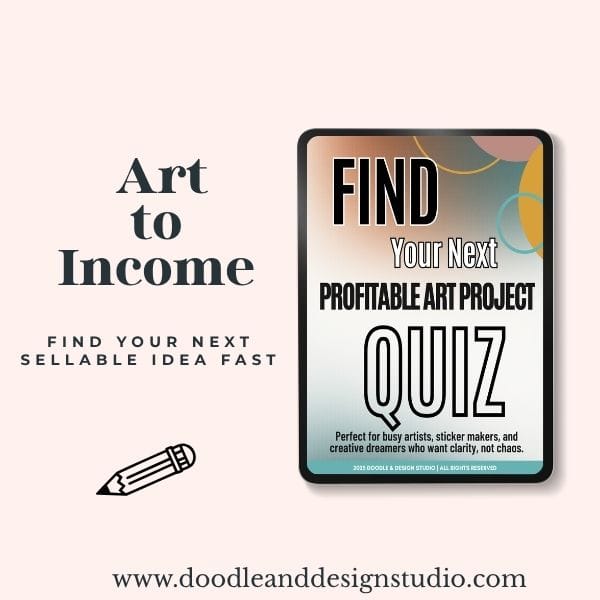
Grab the quiz and find your next art-to-income idea.
I created this quiz to help busy creatives cut through the noise, find focus fast, and feel confident about what to make next.
Want Help Picking Your First (or Next) Digital Product?
If you are staring at your idea list thinking, “Okay but which one do I actually start with,” I made this part easier.
You can take my Pick Your First Product Quiz, which helps you figure out:
- The best type of first product for you to start with
- A GPT prompt you can plug in to map out your whole plan
- Ideas for colors, themes, and directions so you are not stuck at a blank screen
You get a starting point, not just a vague “make something” pep talk. It is built to help you start creating quickly, without getting stuck in indecision.
Then, once you pick that first product, here is a little pro move: Stop at that one product idea and make it several times.
Create a mini series or a small collection of vector graphics, rather than 10 totally different random things. Collect your data, tweak as you go, and your process will get smoother fast.
And if you have already made one product and you are asking “Okay, now what should my next product be,” use the quiz again as your next digital product quiz. Let it guide you to your next smart move with strong earnings potential instead of guessing.
💖 FAQs About Monetizing Digital Art
- 💖 What’s the easiest digital product to start with? Stickers, wall art, or templates — fast wins that teach you the process.
- 💖 Do I need a big shop or email list? Nope — start small and build naturally.
- 💖 Best platform to use? Etsy, Gumroad, PayHip — whichever feels easiest to you.
- 💖 How long until I see sales? It varies — stay consistent and watch what works.
- 💖 What if nobody buys it? Treat it as data, not failure. Tweak and keep going.
- 💖 Can I really earn from digital art? Yes — with the right mix of strategy and joy.
💖 Key Takeaways: Monetize Your Digital Art
- 💖 You don’t need a full plan — start with one simple product.
- 💖 Your messy brain is normal — structure brings results.
- 💖 Batching and tracking = more progress, less burnout.
- 💖 Done is better than perfect — launch, then tweak.
- 💖 Fun matters — joy keeps you consistent and creative.
- 💖 Google Sheets + good vibes > complicated tools and stress.
have you joined the art to income: create & Sell digital products facebook group?
If you’ve ever said, “I want to draw digitally, but I have no idea where to start,” this is your sign.
We learn Procreate tricks, share designs, celebrate tiny wins, and cheer each other on as we start selling what we make.
💕Join Us on Facebook✨
Ready To Get Out Of Creative Chaos?
If your brain has been living in creative chaos land, this roadmap is your way out. Not into a cold, strict system, but into a clear, gentle rhythm that actually fits your life. Start by capturing your ideas. Pick one. Learn just enough. Build a tiny system. Track what happens. Keep it fun.
And when you are ready for help choosing what to make, go take my digital product quiz and let it hand you your next step on a silver platter. Your digital art already has value. Now you have a simple way to unlock its earnings potential too.

🎨 Art to Income Membership
Turn your doodles into dollars — one simple, sellable project at a time.
If you're staring at Procreate wondering how people go from drawing frogs in sweaters to actually selling stuff — you're not alone.
This membership helps you go from “where do I even start?” to having a finished product ready to list.
Each month you’ll get:
💖 One guided project to create and list a finished product
💖 Done-for-you assets to speed things up
💖 Trend + keyword ideas so you know what people are actually buying
💖 A supportive group of artists figuring it out right alongside you
💖 Listing and promo ideas so your art doesn’t just sit in a folder
You don’t need to be techy, trained, or totally “together” — just curious enough to try.
🧩 Want Help Putting All the Pieces Together?
If you're figuring out how to turn your art into income and wish there was a big-picture roadmap to follow — good news, there is.
👉 Read the Ultimate Guide to Making Money with Digital Art🎥 Prefer to learn by watching?
I’ve got a YouTube channel full of quick, no-pressure tutorials made for tired, creative souls like you.
Subscribe here and catch your next creativity boost, one sticker at a time.
Love and messy buns,
❤️
Cynthia McDonald
Helping women find creativity in the chaos — with stickers, stationery, and a little bit of fun
This post may contain affiliate links. I may earn a commission if you make a purchase at no extra cost to you.
Make sure and grab your favorite Pinterest Pin and Save it to your Digital Art Pinterest Board